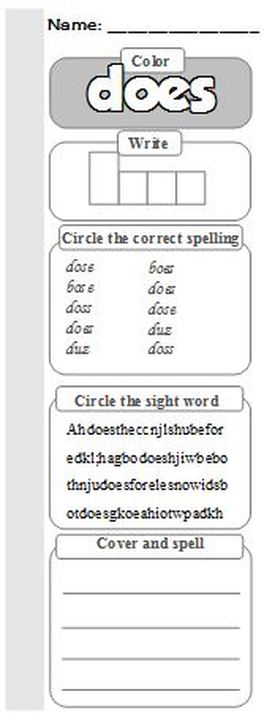
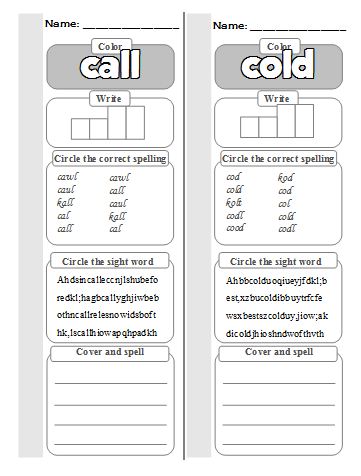
Dolch second grade sight word worksheets are here.  These worksheets are a little more challenging then the ones for first grade and kindergarten.  Students can color and write the words but they can also practice spelling them by covering and spelling the word, picking the correct spelling, and hunting for the word in a string of letters.  
The worksheets will be available free to download until Friday when they will go up for sale.  You can also check out many other great ideas to teach sight words on my teaching sight words page, or at the websites shop. 
Dolch second grade - sight word worksheets
$2.75


Metacognition

Metacognition: The ability to examine ones thought process or thinking about your own thinking

How can metacognition help students to become better spellers

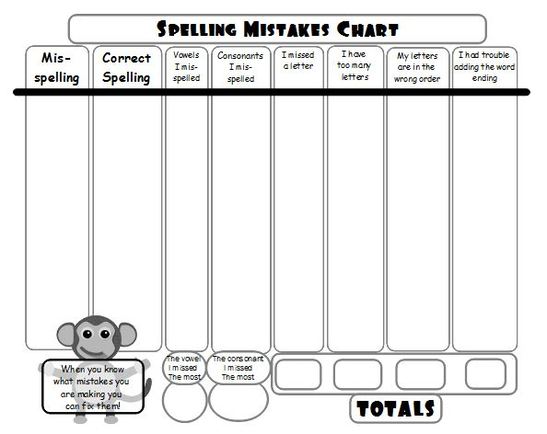
As students use metacognition to think about their spelling mistakes they can use what they have learned to correct their mistakes and become more aware of the types of mistakes that they are making.  Below is a spelling mistakes chart t

Spelling Mistakes Chart

Step 4 in Michelle Newlands Intentional Spelling (2011) is analyze errors and correct them.  She used 5 different categories in her spelling error analysis chart:  phonemic error, orthographic error, missed letters, insertions, and letter reversals.   I've created my own spelling analysis chart but I've changed  a few of the categories.
  1. Vowels I misspelled -  Under this column students will examine the the vowels that they've misspelled.  They will examine the misspelling and the correct spelling and then will but the vowels correct spelling in the box.  If the vowel is a diphthong they will put both letters in the box,  even if they got one of the letters in the diphthong right.
  2. Consonants I misspelled - Students will put the correct spelling of the consonants in the box.  Again if the consonant is a diphthong or a blend they will put both letters in the box.
  3. I missed a letter - The letter that was missed will go in the box.
  4. I have too many letters -  If there word has too many letters they will put a check-mark here.  
  5. My letters are in the wrong order -  Students will write the letters that they reversed in the correct order
  6. I had trouble adding the word ending -  If students had trouble following the rules for adding word endings like (ing, ed, ful, etc.)  they will write the word ending plus two letters in this box.

How to use the chart

After filling in all of the words and misspellings,  students will add up the total of the misspelling at the bottom.  For the Vowels and consonants misspelled students will examine the letters and determine if they are missing one vowel or consonant more than the others.  For the rest of the columns students will count each instance of the type of mistake and put the total at the bottom.  They then can analyze which type of mistake they are making the most of.  

Once they have finished the chart I would have my students set a spelling goal to work on based on there chart.  Once the goal has been set the teach and student can figure out different ways that they can work on their goal.  
Spelling Mistakes Chart
File Size: 52 kb
File Type: pdf
Download File

Newlands, M. (2011). Intentional spelling: Seven steps to eliminate guessing. The Reading Teacher, 64(7), 531-534.    
 
 
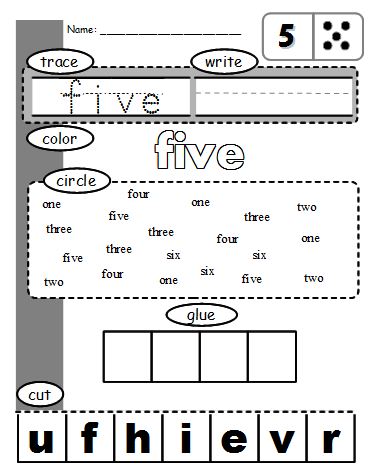
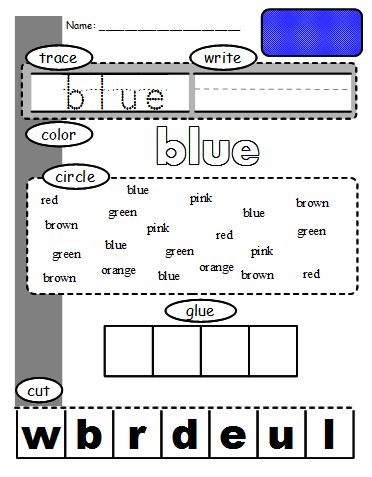
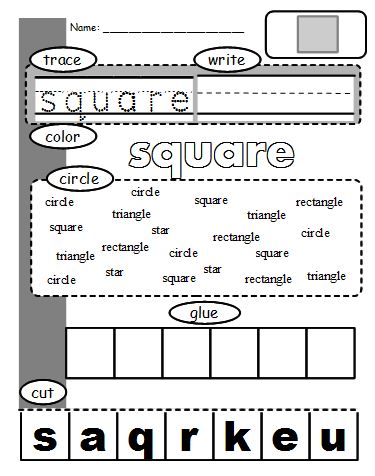
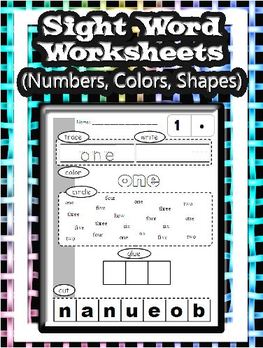
I had a request to create a new sight word worksheet packet,  one for number, color, and shape words.  So here it is.  Sight word worksheets:  Numbers, Colors, and Shapes.  These new worksheets are just like my Fry's Kindergarten and first grade worksheets, which you can get by clicking on the link.  The only difference is that in these new worksheets a representation of the word is in the right hand corner of the worksheet.  

So, for a number word,  in the right hand corner will be the numbers symbol as well as the number in dots.  For color words,  the color will be in the right hand box,   and for shapes words the shape will be in the right hand corner.  
The free giveaway of these worksheets is now over.  If you don't want to miss out on the next giveaway you can follow me on Facebook, Pinterest, or Twitter.

You can get these worksheets now on the new websites shop
 
 
Students benefit from having opportunities to examine words in purposeful and guided lessons that encourage them to develop their powers of observation an their critical skills of inquiry. (Newlands, 2011)
It's Monday again and that means its time to continue our study of the great article by  Michelle Newlands (2011) called  Intentional spelling:  Seven steps to eliminate guessing.  Each week I will be going over one of the seven steps and providing ideas and activities for you to use in applying that step to your spelling instruction.  

Today's step: Observe patterns and trends is all about helping students to make connections about different spelling patterns.  For example:  if students notice that the last four letters in these two words (light, sight) are the same and sound the same.  Then spelling words with similar patterns (night, right, flashlight, tight) becomes much easier.  

The following activities can help students recognize patterns between words.

Spelling Activities 

Making Words

Making words is a manipulative activity, originally developed by Patricia Cunningham, where students can learn patterns in words through rearranging a set number of letters and trying to find out the big word that those letters will make.  The above video describes the benefits of using a making words lesson.  The next video is a lesson that you can use after the making words activity to focus students attention on the patterns in the words.

Word Families

Word families are groups of words that have the same ending pattern.  There are numerous activities that you can use with word families.  A few that I've created are:
   Nursery Rhyme Themed Word Family Games
   Give a dog a bone - File folder games
   Phonics Word Wheels


Another site that I love that has tons of free printables for word families is a site called WordWay.  When I say tons of stuff I really mean it,  this is an excellent site.

Word Ladders

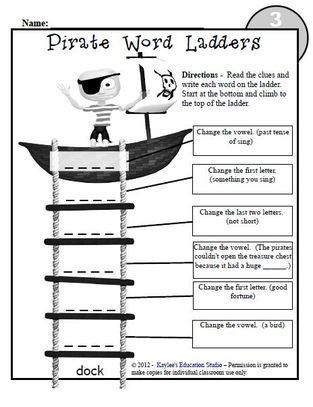
Word ladders are a great activity for students to recognize patterns between words.  A word ladder starts with a word at the bottom of the ladder.  The objective is to change the first word into the second word by changing parts of the original word using clues and directions into new words until you reach the top of the ladder.

There are numerous commercial word ladder that you can purchase but I've got a great set of word ladders for first and second grade that you can get for only $3.50.

These word ladders are all Pirate themed so they can be more motivating for students to complete.
Picture
Click on the link to learn more about these great pirate word ladders.

Word Sorts

You can also have your students do word sorts to identify spelling patterns.  There are two main types of word sorts, open and closed.  A closed word sort is when the spelling pattern is already identified and students must sort the word according to those patterns.  In an open word sort the student is the one who determines how they want to categorize the words.
Newlands, M. (2011). Intentional spelling: Seven steps to eliminate guessing. The Reading Teacher, 64(7), 531-534.  
 
 
There is a great anchor chart set from The Teacher Wife blog about when to double the final consonant when adding ing or ed.  You can click on the link to go to her blog and get the posters for the chart for free.
 
 
In my professional reading about spelling instruction I've just come across a great article in the reading teacher by Michelle Newlands (2011) called Intentional spelling:  Seven steps to eliminate guessing.  Its a great article and I would encourage everyone to read it.  

When I was reading the article however I got a great idea for a series on blog posts.  So I'm going to write one blog post about each of the seven steps and hopefully give you resources, ideas, and activities for implementing that step in your spelling instruction program.  So since this is the first day, I'm going to cover the first rule,  Know the spelling rules.

Know the spelling rules

There are over one million words in the English language. How can anyone learn how to spell those words be memorizing them one at a time.
English spelling can seem chaotic or even random at times, for example consider the following words Wednesday (do you here a d in that word, because I sure don't), thumb, know, should, (there are lots of silent letters in English) and of course there are words that look the same like tear and tear that are spelled the same but sound completely different.  Not withstanding these examples English spelling does follow some rules.  Being able to understand the structure of English spelling can make spelling new and unfamiliar words seem less daunting.  

Common spelling rules

  1. I before e except after c - When you think of spelling rules the one that usually comes to mind first is, "i before e except after c."  You might not have heard of the next line though, "or when pronounced ay as in neighbor or weigh.  Other exceptions are: weird, species, science, sufficient, foreign.   To see more exceptions you can go to this Wikipedia article.
  2. Prefixes do not change the spelling of words they are added to. - They don't even change when the prefixes last letter and the first letter of the word are the same.  Ex - misspell, impossible, reenter,  unlucky,  unnoticed.   For a list of prefixes, their meanings and words you can visit  EPS, go to the bottom of the page under Pedagogical Information and click on Prefix and Suffix word list information.  You can also download Little blue men from space game  for a prefix and suffix game.
  3. The letter q is always followed by u. -  Exceptions:  there are several words with foreign origins (often arabic) that don't use u.  Ex:  burqua, qadi(a muslim judge),  qi (often spelled chi, or ki,  Chinese for life force.)
  4. In open syllables vowels at the end of the syllable are often long -  Ex:  belong, protect, table, paper  Exceptions:  the vowel i may say it's name or it may sound like "ee" 
Picture
Spelling rules usually have many exceptions.  When your teaching a rule don't forget to have some examples of words that don't follow the rule.   Teaching the exceptions will greatly increase the number of words that students will be able to spell correctly. 

For more complete lists of English spelling rules you can visit the following links:
Newlands, M. (2011). Intentional spelling: Seven steps to eliminate guessing. The Reading Teacher, 64(7), 531-534. 
 
 
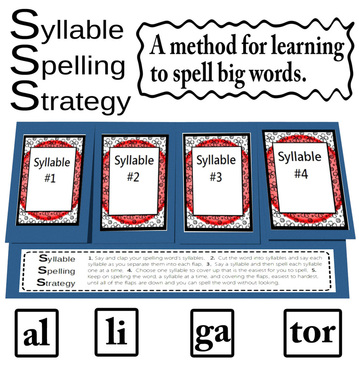
So I've taken the SIP (Spelling in Parts) strategy by Debbie A. Powell and Roberta Aram (2008) and tweaked it a little to make it a little more physical for my kinesthetic learners.  Now instead of just circling the syllables they will be cutting the word up and using a fun foldable to learn the word.  You can download the foldable for free at the bottom of this post.
Picture
Steps

1. Say and clap your spelling word's syllables. 

2.  Cut the word into syllables and say the syllable as you separate them into each flap.

3.  Say a syllable and then spell each syllable one at a time.

4.  Choose one syllable to cover up that is the easiest for you to spell.

5.  Keep on spelling the word, a syllable at a time, and covering the flaps, easiest to hardest, until all of the flaps are down and you can spell the word without looking.

Syllable Spelling Strategy
File Size: 435 kb
File Type: pdf
Download File

Powell, D. A., & Aram, R. (2008). Spelling in parts: A strategy for spelling and decoding polysyllabic words. The Reading Teacher,61(7), 567-570. 
 
 
So this summer I'm focusing my professional reading on spelling instruction and today I came across this wonderful strategy by Debbie A. Powell and Roberta Aram (2008) in The Reading Teacher.   This strategy requires that break apart the word into syllables (not that earth shattering, I know)  and then learn to spell each syllable instead of memorizing a whole word at a time.   

So many kids looks at a big word and then get immediately overwhelmed when trying to learn how to spell it.  This strategy helps, by breaking up spelling the word into more manageable parts.  The steps to this strategy are: 
  • Say and clap the word's syllables.
  • Divide the word into it's syllables and pronounce each syllable.
  • Say a syllable, then spell it, say a syllable, then spell it.
  • Circle syllables with harder spelling patterns.
  • Create a mnemonic device for the syllable.  (I would think that this step is optional)
  • Cover, say a syllable, write the syllable, say a syllable, write the syllable, etc.
Powell, D. A., & Aram, R. (2008). Spelling in parts: A strategy for spelling and decoding polysyllabic words. The Reading Teacher,61(7), 567-570. 
 
 
Picture
Many of the students that I'm tutoring this summer are all struggling with the same thing:  Spelling.  The bring 10 spelling words home and test on Friday just isn't working for them. 

I do have a great phonics activity called Pirate word ladders,  that can help students start thinking about different spelling patterns but I want tons more ideas.

So my new project this summer is to focus on spelling instruction.  I'm going to go on a professional reading spree about the subject and share my thoughts and creations with you.  My first goodie that I've found is at the Teachem2think site.  About half way down the page is a great chart on fun ways to practice spelling.


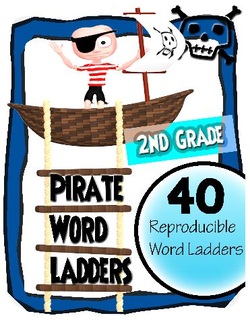
2nd Grade Pirate Word Ladders
My Second Grade - Pirate Word Ladders are finished.  These word ladders cover important skills needed in second grade.  Like learning contractions, some common prefixes and suffixes like:  un, re, ture, s, es, and ies.  

They also cover many different word patterns like: r-controlled words, ght, ph, kn, mb, and more. As well as many different vowel patterns. 

Not only will these ladders help students to spell the words included, they will help students when trying to decode unfamiliar words that they come across.

You can download a preview of the word ladders below or you can purchase all 40 of them for $3.50.


You can get these worksheets now on the new websites shop

Preview
File Size: 137 kb
File Type: pdf
Download File


Privacy Policy